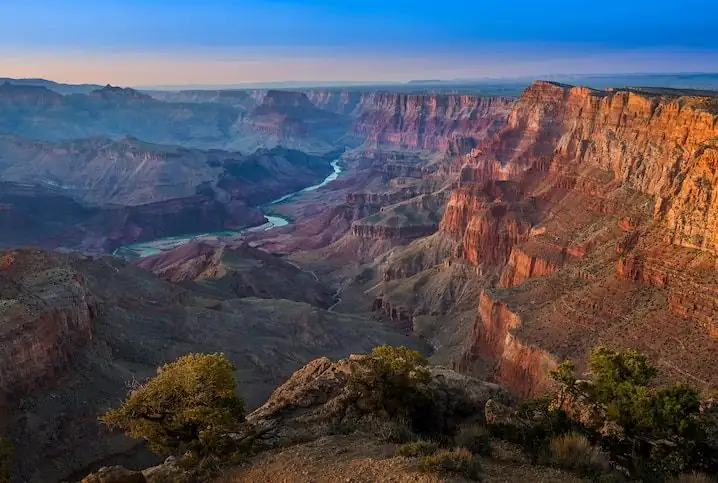
Start here: South Rim basics
The South Rim is the Grand Canyon most people picture — the widest views, the historic lodges, and open year-round. (The North Rim is seasonal and a five-hour drive from the South Rim; Grand Canyon West and the Skywalk are a separate destination on tribal land, closer to Las Vegas. Don't mix them up when booking tours — it's the most expensive mistake first-timers make.)
- Getting there: About 3.5–4 hours by car from Phoenix (I-17 to Flagstaff, then US 180 or I-40/SR 64), about 1.5 hours from Flagstaff, and about 80 miles from Williams on SR 64 to the South Entrance. There's no substitute for a car unless you take a guided tour.
- Entry: The park charges a per-vehicle entrance pass, valid for several days; an America the Beautiful pass also works. Check nps.gov for current fees and any timed-entry or reservation requirements before you go — rules change.
- Elevation: The rim sits around 7,000 feet. Expect cooler air than Phoenix (often 25–30°F colder), stronger sun, and to get winded faster. Winter brings real snow; summer brings afternoon monsoon storms.
- Time needed: One full day minimum for the highlights. Two days lets you hike below the rim and catch both sunrise and sunset without rushing.
[AFFILIATE: hotels in Grand Canyon Village and Tusayan] · [AFFILIATE: rental cars at Phoenix Sky Harbor]
Where to stay
- Inside the park (Grand Canyon Village): Historic lodges like El Tovar and Bright Angel Lodge sit right on the rim — walk out your door to the view. They book up months ahead for spring, summer, and fall; reserve the moment your dates are set.
- Tusayan: The gateway town just outside the South Entrance, with chain hotels, restaurants, and an IMAX theater. Five minutes to the gate, usually easier availability than in-park lodges.
- Williams or Flagstaff: Cheaper and livelier at night, but 1–1.5 hours from the rim — fine for a road trip base, poor for sunrise at the canyon.
[AFFILIATE: hotels in Tusayan] · [AFFILIATE: Grand Canyon in-park lodges]
The one-day plan that works
1. Arrive early, park once
Enter before 9 a.m. in busy seasons — entrance lines and Visitor Center lots build fast by late morning. Park near the Grand Canyon Visitor Center at Mather Point, then use the park's free shuttle system for the rest of the day instead of moving your car.
2. First view: Mather Point, then the Visitor Center
Mather Point is minutes from the parking lots and delivers the classic first canyon panorama. Then spend 20 minutes in the Visitor Center: the film, exhibits, and ranger advice will make everything else you see make more sense.
3. Walk the Rim Trail to Grand Canyon Village
The Rim Trail runs roughly 13 miles along the rim, mostly flat and much of it paved. Walk the section from Mather Point west through Yavapai Point (stop at the geology museum) to the historic Village — about 3 miles of continuous viewpoints, and you can hop a shuttle back whenever you're done. Explore the Village's historic buildings: El Tovar, Hopi House, Bright Angel Lodge, and Lookout Studio.
4. Afternoon: pick ONE direction
- Hermit Road (west): Closed to private cars most of the year (roughly March through November) — ride the free shuttle and hop off at Maricopa, Powell, Hopi, and Mohave Points. Hopi and Mohave are the sunset favorites.
- Desert View Drive (east): Open to your own car — about 25 miles of overlooks (Grandview, Lipan Point) ending at the Desert View Watchtower, a 70-foot stone tower with some of the widest views in the park, including the Colorado River.
Trying to do both directions plus a hike in one day is how people end up seeing the canyon from a windshield. Choose one.
[AFFILIATE: Grand Canyon guided day tours] · [AFFILIATE: Grand Canyon helicopter tours]
5. Sunset, then stay for the stars
Sunset crowds concentrate at Hopi Point and Mather Point; any west-facing overlook works. After dark, the South Rim's night sky is a headline attraction on its own — on moonless nights the Milky Way is obvious to the naked eye.
Should you hike below the rim?
Yes — even a short descent changes the experience completely — but respect the rules. The two corridor trails from the Village area are Bright Angel Trail (more water and shade, a good first descent to the first tunnel or the 1.5-mile resthouse) and South Kaibab Trail (steeper, no water, bigger views; Ooh Aah Point is about a mile down). The iron rule: double your descent time for the climb back up, carry water and salty food, and never attempt the river and back in one day. In summer, be off the inner-canyon trails by mid-morning.
First-timer mistakes to avoid
- Booking a "Grand Canyon tour" that goes to the West Rim/Skywalk when you wanted the national park (or vice versa).
- Arriving at noon in peak season and spending your day in entrance and parking queues.
- Driving to every viewpoint instead of using the free shuttles.
- Underestimating the altitude, sun, and dry air — hydrate before you feel thirsty.
- Trying to combine the South Rim with Sedona or Antelope Canyon in the same day. Each deserves its own day; our 7-day Arizona road trip shows how to sequence them.
- Showing up without a lodging reservation in peak season and hoping for a walk-in. There is no reliable walk-in.
Keep reading
Two more canyon trips worth knowing: Havasupai Falls, the turquoise falls at the bottom of Havasu Canyon, takes a permit and a plan — our guide covers both. And if Page is on your route, our Antelope Canyon photography tips will get you the beam shot.
About & Disclosure
TRVL Guide is a travel resource site. Some links on this site may be affiliate links — if you book through them, we may earn a commission at no extra cost to you. It helps keep the guides free.