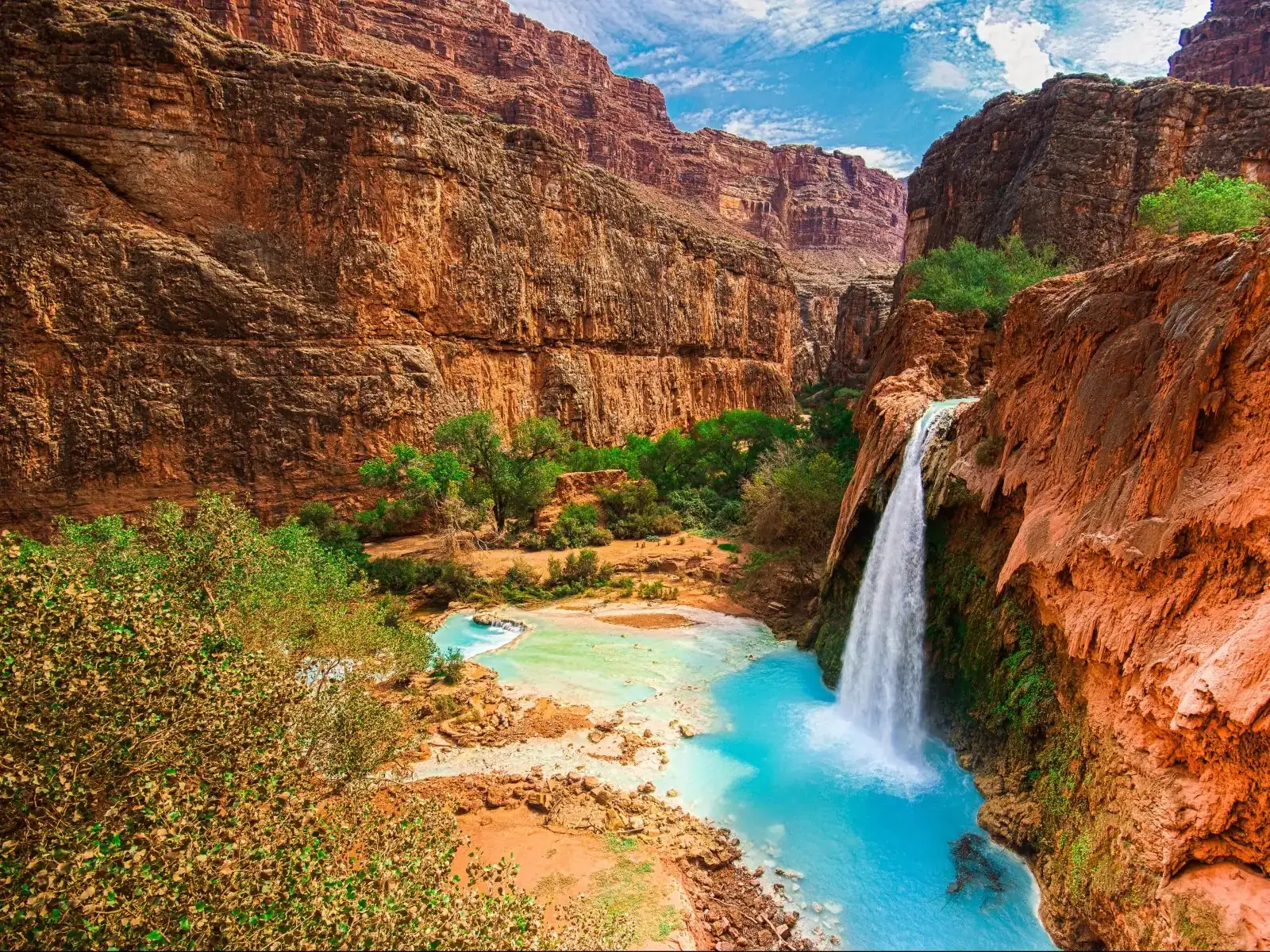
Deep inside a side canyon of the Grand Canyon, Havasu Creek runs a color that looks Photoshopped and isn't. The water is saturated with calcium carbonate, which coats the canyon floor in pale travertine terraces and reflects back an impossible blue-green — the color behind the name Havasupai, "people of the blue-green waters." Along ten miles of that creek sit five major waterfalls, a campground in the cottonwoods, and Supai Village, home of the Havasupai Tribe and routinely called the most remote community in the contiguous United States: no roads in or out, reachable only on foot, on horseback, or by helicopter.
There is no casual way to do this trip. Every visitor needs a permit from the Tribe, bought in advance through a single website. There is no day hiking — none — and every permit is a four-day, three-night commitment. The hike in is ten miles with everything on your back unless you pay a mule to carry it. Permits for the whole season go on sale on one February morning and the best dates vanish in minutes.
None of that is a deterrent to the people who go. It's the filter that keeps the canyon the way it is. This guide covers the entire process in the order you'll face it: winning the permit, checking in, walking the ten miles, deciding on mules or the helicopter, visiting the falls in downstream order, packing, and respecting the rules of a sovereign nation's home — because that is exactly where you'll be a guest.
The hard part: getting a permit
There is exactly one place to get a permit: the Tribe's official booking site, havasupaireservations.com. Not a lottery site, not a tour company, not a resale marketplace. The Tribe's terms are blunt about it — resold or transferred permits are invalid, and entering the reservation without a valid permit is trespass.
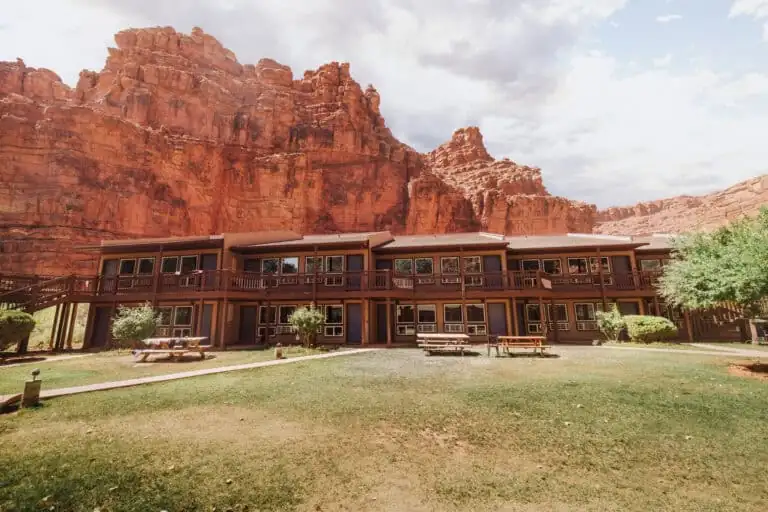
You have two ways to sleep down there. A campground permit costs $455 per person (2026 rate) for the full three nights, with all permits, fees, and taxes included. Or book the Havasupai Lodge in Supai Village — a simple motel-style room with beds, a bathroom, and electricity — at $2,277 per room for three nights (2026 rate), covering up to four people. Every reservation, either way, is exactly four days and three nights. You can't buy two nights, and you can't extend except by stacking a second booking if one exists.
The campground season runs February 1 through November 30; the lodge opens later, April 1 through November 30. The canyon closes to visitors entirely in December and January. One booking can hold up to 12 campground permits, and you'll pay for everyone in full, up front, the moment you book — bookings can't be changed afterward, so the names and headcount you enter are the ones you're committed to.
Name your PATLs — this matters more than you think
At booking, and only at booking, you can name up to two Potential Alternative Trip Leaders (PATLs). A PATL can check the group in with their own photo ID if the trip leader can't make it. Because permits can't be transferred or renamed later — ever — the PATL line is your only insurance against the trip leader's life getting in the way. Fill it in. It costs nothing and cannot be added after payment.
Check-in happens on Route 66, not at the trailhead
Before anyone hikes, the trip leader (or a listed PATL) must check in in person at the Grand Canyon Caverns Inn, Mile Marker 115 on Route 66 near Peach Springs — the day before your start date, or the day of. Bring photo ID that matches the booking name. You'll get a wristband for every person on the booking (wristbands stay on for the entire trip), tags for packs and tents, and you'll register the license plate of every vehicle parking at the trailhead for its parking permit. Check-in office hours shift with the season — recent seasons have run roughly 8 a.m. to 5 p.m. the day before, with day-of check-in ending at noon — and the Tribe emails current hours before your trip. Check in the day before if you possibly can: the inn sits about 65 miles and a good hour-plus of driving from the trailhead, and there is a boundary checkpoint about five miles before the trailhead where your paperwork gets inspected. Skip check-in and your permits are cancelled with no refund. Many groups simply sleep at the Caverns Inn or in Seligman the night before.
When permits go on sale: the February 1 playbook
The system was overhauled for 2026. The old lottery is gone; permits are now first-come, first-served online — which moves the contest from luck to preparation and internet speed. The 2026 season opened in two waves:
- Early Access: January 21, 2026 at 8:00 a.m. Arizona time through January 31 at 5:00 p.m. Same permits, plus a non-refundable early access fee — $40 per person for the campground, $160 per lodge room.
- General sale: February 1, 2026 at 8:00 a.m. Arizona time, standard prices, until the season sells out.
Arizona does not observe daylight saving time — in February, Arizona time equals Mountain Standard Time, so convert carefully from wherever you are. Prime dates (spring weekends, May, early fall) can go in minutes. The playbook that actually works:
- Create your account days early on havasupaireservations.com and complete your profile. Do not let sale morning be your first login.
- Be logged in before 8:00 a.m., card in hand. Once you select dates, a checkout timer starts — fumbling for a payment card is how dates get lost.
- Rank your dates. Have a first choice plus two or three backups, and decide in advance whether your group splits or moves as a block.
- Flexibility wins. Weekdays and shoulder-season dates (February, March, October, November) are far easier than May and September weekends. Smaller groups fit into gaps big groups can't.
- Run more than one device — a laptop on Wi-Fi and a phone on cellular — and have a friend try simultaneously if your group allows it. Whoever gets through books for everyone, up to the 12-permit cap.
- Print everything. Confirmation, receipts, permit details. You'll need paper copies at check-in, and there is no printer at the bottom of the Grand Canyon — or much cell signal to pull them up with.
Rates are set fresh each season and announced on the official site before the sale. The 2026 prices above held flat from 2025 — budget for the possibility that yours don't.
The transfer list is gone: your real second chance
Older guides — and older advice all over the internet — will tell you about the official cancellation and transfer list, where permit holders posted unwanted dates and anyone could claim them for a fee. That system was retired with the 2026 overhaul. Under the current terms, permits are strictly non-transferable and non-resellable; a permit in someone else's name is simply not valid at the checkpoint. Anyone offering to "sell" you their Havasupai permit is offering you an expensive piece of paper. The PATL designation, made at booking, is the only name flexibility that exists.
So what replaces the transfer list? Cancelled bookings go back into the reservation site's inventory. The Tribe's cancellation policy creates the supply: cancel 90 or more days before your start date (through your online account) and you get 50% of the permit fee back — the early access fee is never refunded. Inside 90 days, cancelling returns nothing at all, no exceptions, not even for weather. That 50%-back deadline means a steady trickle of dates shake loose as trips approach their 90-day marks, and they reappear on havasupaireservations.com for whoever refreshes first.
Play it like this: check the booking site often — early mornings are a good habit — keep your dates wide open if you can, and jump the moment something workable appears. Shoulder-season and weekday dates surface far more often than prime weekends. It rewards the flexible and the patient, which, honestly, is the theme of this entire trip.
The hike in: 10 miles, honestly
Start with the drive. From Route 66 just east of Peach Springs, Indian Road 18 runs about 60 paved miles north to Hualapai Hilltop — no fuel, no food, no water, no reliable cell service, and free-range cattle and elk on the asphalt. Budget roughly 3.5 to 4 hours from Las Vegas (about 220 miles total) or 4 to 5 hours from Phoenix (about 260 miles). Fill the tank before you turn off 66.
Hualapai Hilltop sits at about 5,200 feet: a big dirt parking lot on the canyon rim, portable toilets, your parking permit on the dashboard, and nothing else — no water, no supplies, and no sleeping in your vehicle the night before. The trail leaves the rim immediately.
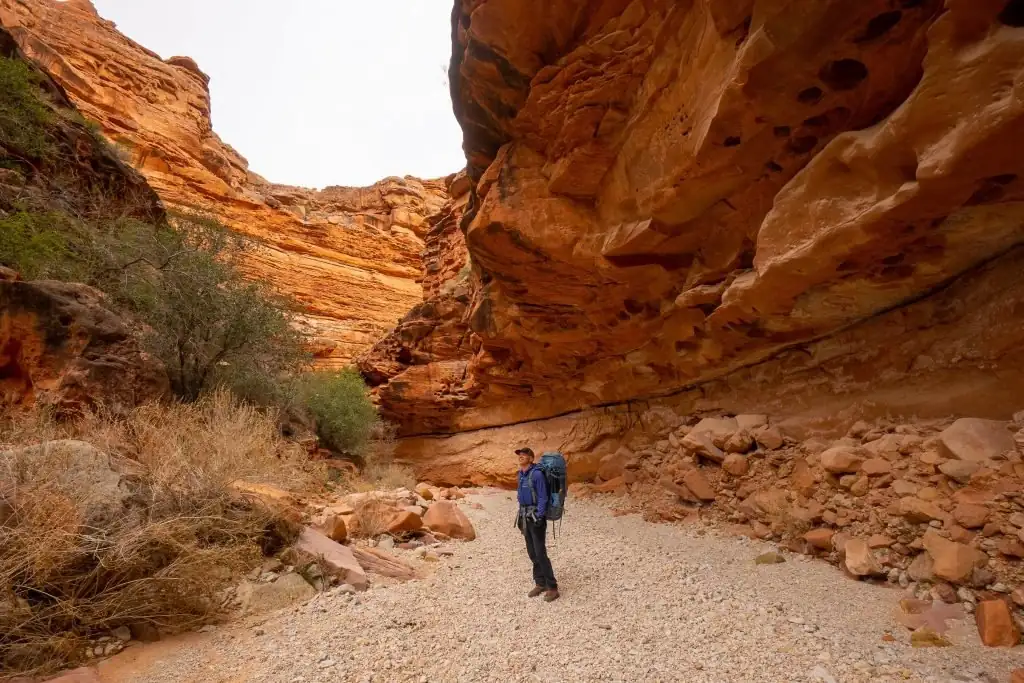
The first mile and a half is the steepest of the trip: a staircase of switchbacks dropping roughly 800 feet off the rim. Then the trail settles into the gravel wash of Hualapai Canyon for about six and a half miles, losing another 1,200 feet so gradually you'll forget you're descending — until the hike out reminds you. Around mile six the wash meets Havasu Creek, the walls green up, and at mile 8 you reach Supai Village (about 3,200 feet): the lodge, a small store, a café, and the tribal offices. Walk through respectfully and keep your camera put away — more on that below.
Two miles below the village, the canyon becomes the postcard. You pass Fifty Foot Falls and Navajo Falls, then Havasu Falls itself, and the campground begins just beyond it. Trailhead to campground: 10 miles, about 2,400 feet of descent (the campground sits near 2,800 feet), typically four to six hours going down. The return is the same ten miles with the elevation run in reverse — most people take five to seven hours out, and in warm months the correct start time is before dawn.
Water is the whole game out here
There is no water at the trailhead and none anywhere on the trail until the village, eight miles in. Carry at least three liters per person for the hike down — a full gallon in summer — and start hydrated. In camp, life runs on Fern Spring, a freshwater spring piped to a spigot near the campground entrance: the Tribe lists it as the campground's drinking water source, and generations of campers have filled straight from it. Every other source — the creek included — gets filtered or treated first. On the way out, refill everything at Fern Spring before you start; the next certain water is your car, ten uphill miles away.
[AFFILIATE: hotels near Peach Springs & Seligman] · [AFFILIATE: rental cars in Las Vegas]
Mules & the helicopter
Pack mules: your gear rides, you don't
The mule trains of Havasupai are famous — this is still a place where supplies arrive on four legs. For visitors, mules carry bags only, never riders, and the service is a genuine luxury on ten miles of gravel. Reserve and pay for mules when you book your permit — arrangements must be made prior to or at the time of booking. The 2026 rate is $400 per mule, round trip, and one mule carries up to four bags with a combined weight of no more than 130 pounds — call it 32 pounds a bag. Bags must be duffle-sized (no larger than about 36 by 21 inches); a cooler is allowed within limits (48 quarts max). Drop bags at the Hilltop corral by 10 a.m. on your start date and they'll be waiting near the campground by late afternoon, around 5 p.m. Keep day-one water, food, medication, and your swimsuit in your daypack — your tent is on a mule until evening. On departure day, bags go to the campground drop by 7 a.m. and reach the top around midday; miss the drop and fees for a late run run to several hundred dollars.
On the trail, mules and horses have the right-of-way, always. Step well off the treadway, stand still and quiet, and let the train pass. Per tribal rules, don't photograph the pack trains or try to pet the animals.
The Airwest helicopter: a maybe, never a plan
A helicopter run by Airwest Helicopters links the Hilltop with Supai Village in about ten minutes, and it tempts every hiker staring up at the switchbacks on day four. Understand what it is: a private, third-party service the Tribe explicitly does not guarantee — it can be grounded, full, or simply not flying, for weather or any other reason, and the Tribe's terms say so in plain language. There are no reservations; seats are first-come, first-served on the day (for the flight out of the village, a day-before sign-up list has been offered since 2025). Flights typically run Sundays, Mondays, Thursdays, and Fridays, starting around 9 or 10 a.m., weather permitting. The 2026 fare is $300 per person, one way, with extra luggage around $50 a bag — pay on site, bring cash, because the card reader's signal is unreliable and cards carry a surcharge. Boarding priority runs tribal members first, then tribal business, then tourists; on a busy morning you can sign up early and still watch the canyon shadows lengthen. And note the fine print of geography: the helicopter lands in the village, which is still two miles from the falls and campground. Book the trip you'd happily hike both ways; treat a seat on the helicopter as a bonus, never the plan.
The falls, in order
From Supai Village, one trail threads down Havasu Canyon past all five falls. Walk it in this order on day one and you'll have the canyon's map in your head for the rest of the trip.
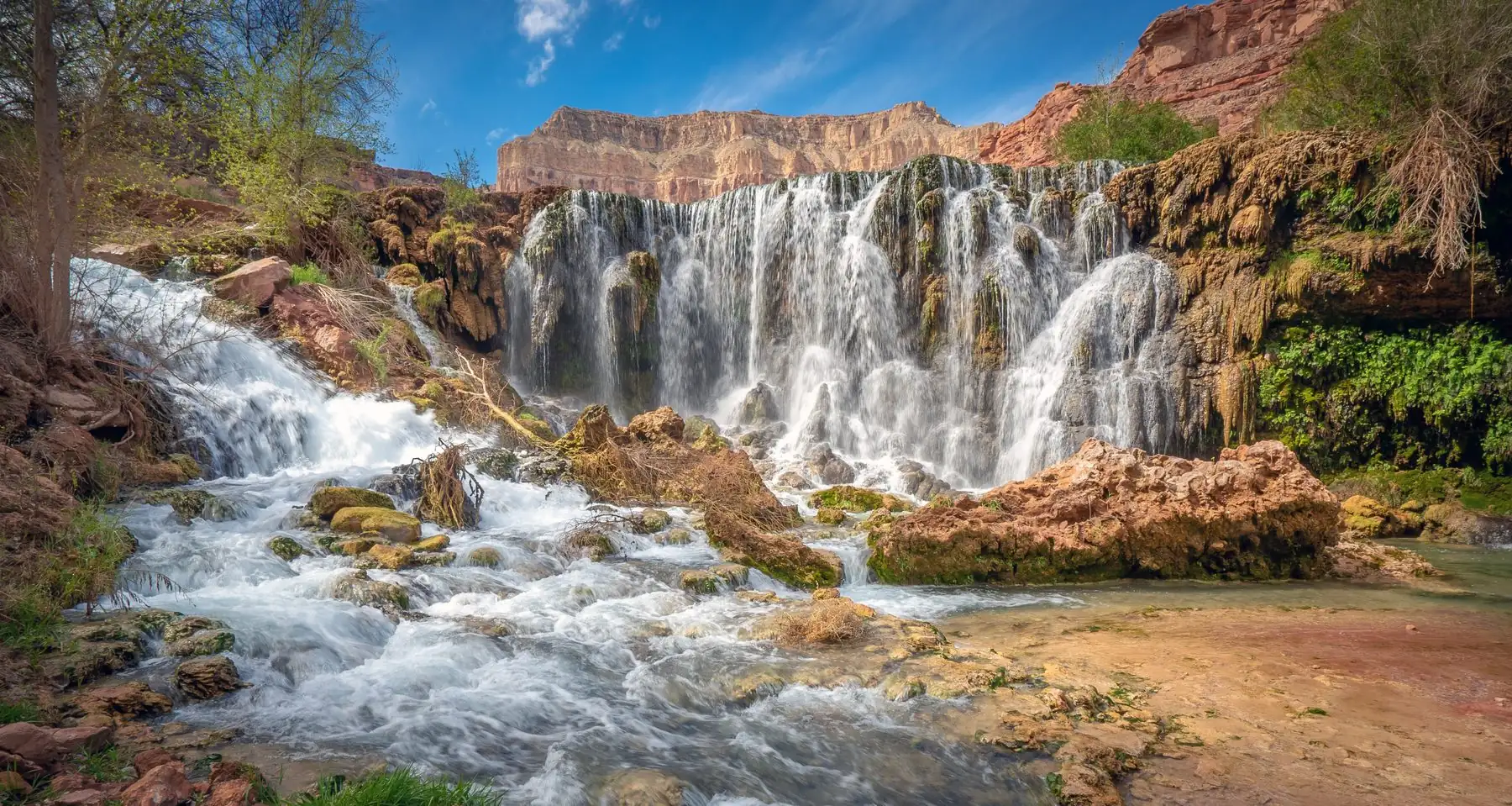
Fifty Foot Falls
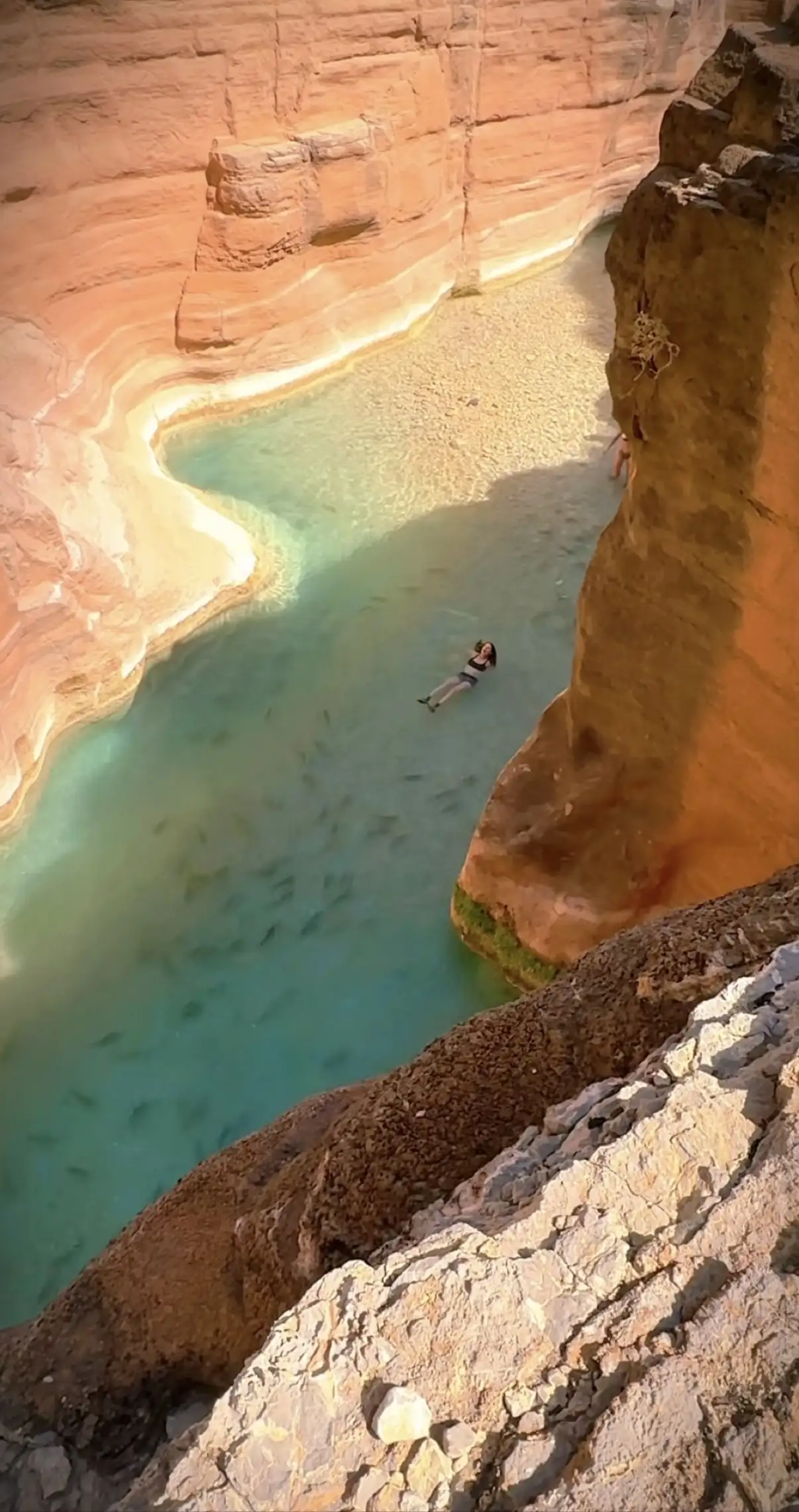
About a mile below the village, the creek spreads into a wide, multi-channel curtain pouring over a travertine shelf — lower, broader, and quieter than its famous neighbors, with swimmable pools at its base and a fraction of the company. It's the connoisseur's first stop and an easy one to have nearly to yourself in the morning.
Navajo Falls
Just downstream, Navajo Falls (with its smaller neighbor, Little Navajo) drops in steps and chutes through the greenery. It's the youngest of the named falls — the creek re-cut this stretch after a major 2008 flood rearranged the canyon — and it feels like it: intimate, lush, and easy to walk past if you're rushing toward the big names. Don't rush.
Havasu Falls
The icon. A single plume drops about 100 feet off a red travertine wall into a broad turquoise amphitheater of a pool — the photo that launched ten thousand permit attempts. The campground begins just below it, so this is your front yard for three days. Swim, wade the travertine ledges, and take the classic shot from the trail above. What you don't do is climb or jump from the falls or the walls — it's prohibited, and the travertine is more fragile than it looks.
The campground
Three-quarters of a mile of creekside sites stretch from below Havasu Falls toward Mooney Falls: first-come, first-served, many with picnic tables, all within earshot of the creek. Composting toilets are spread along the grounds, Fern Spring's spigot is near the entrance, and a frybread stand near the top of camp opens when it opens — bring cash and no expectations. Quiet hours run 8 p.m. to 5 a.m., camping is prohibited within 150 feet of any waterfall, and permits end hard: out of the campground by 11 a.m. on day four.
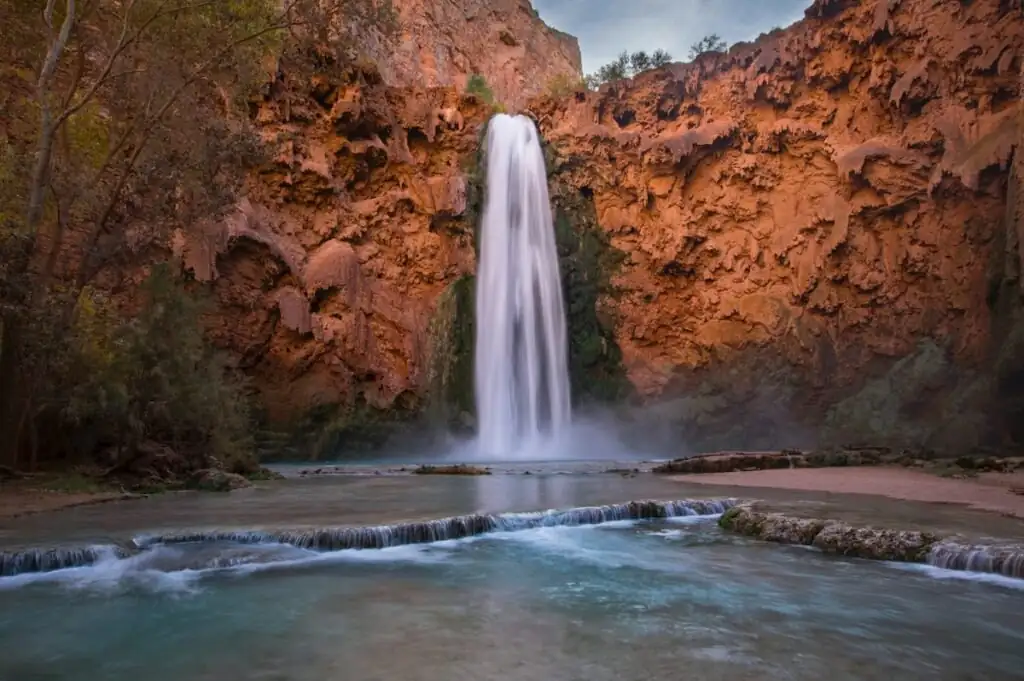
Mooney Falls
At the far end of camp, roughly a mile below Havasu Falls, Mooney drops nearly 200 feet — the tallest of the named falls, a full roar in a stone amphitheater of its own. Getting to its base is the trip's signature adventure: the trail passes through two short tunnels blasted in the travertine, then descends the cliff on chains, pegs, and ladders, slick with Mooney's own mist. It's exposed, it's one person at a time in the steep sections, and garden or climbing gloves earn their keep here. Hesitant about heights? The view from the top is still the best picnic spot in the canyon.
Beaver Falls
About three miles below Mooney — roughly four miles from camp — Havasu Creek stacks itself into a staircase of turquoise cascades and swimming holes. The route crosses the creek repeatedly (this is what the water shoes are for), passes the ladder-and-ledge sections below Mooney, and opens into the most playful water in the canyon. Give it a full day, carry water and a filter, and start back with daylight to spare.
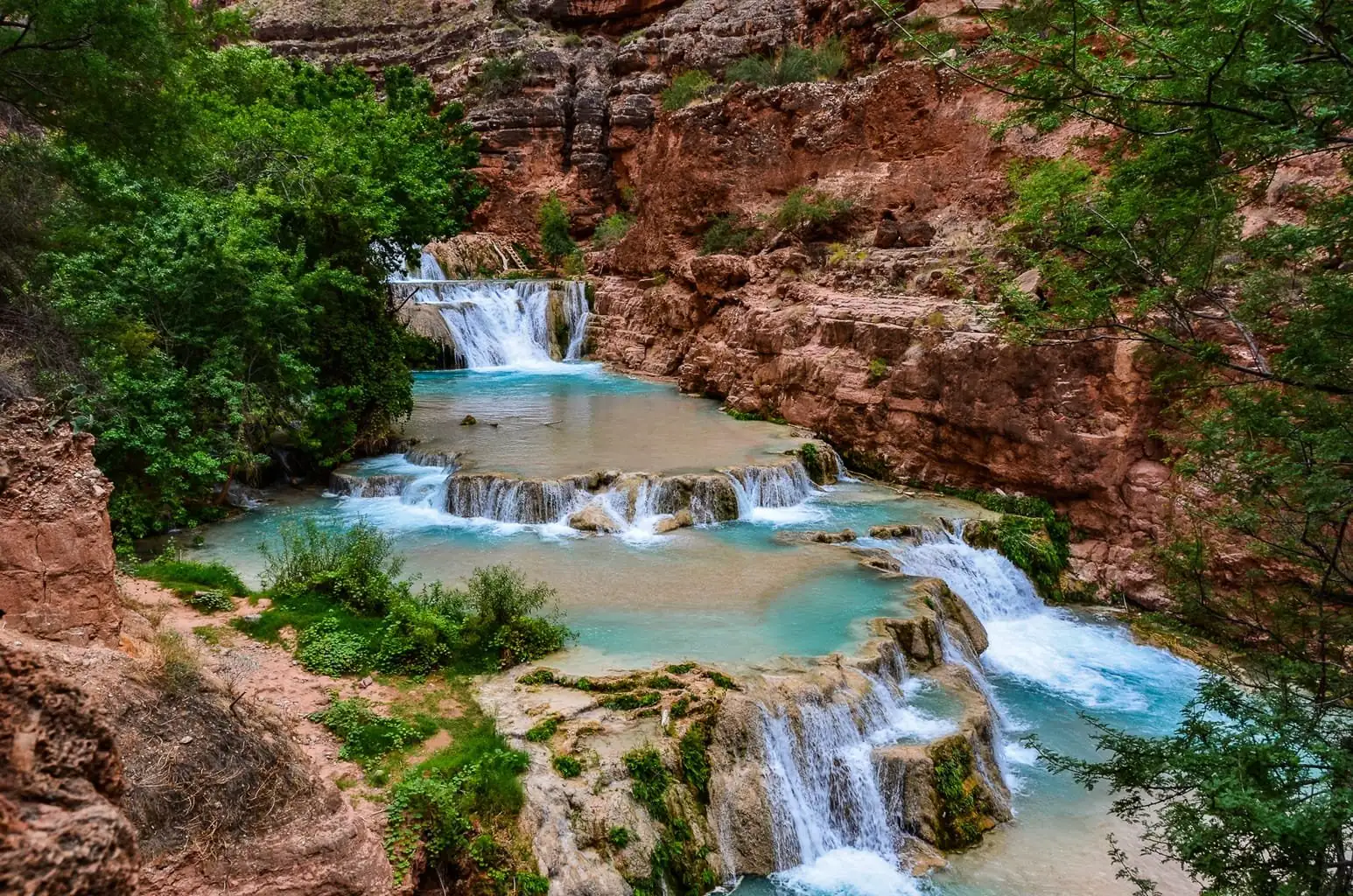
Strong hikers can push on to the Confluence, where Havasu Creek pours into the Colorado River — about six miles below the campground. It's a dawn-to-dusk day with constant creek crossings; know your turnaround time before you start.
What to bring: the full list
Water & food
- Hydration bladder or bottles totaling at least 3 liters capacity — a gallon's worth of carrying capacity in summer — plus electrolytes. This is the single most important item on this page.
- A water filter or treatment as backup for creek water (Fern Spring is your primary source; everything else gets treated).
- Every meal for four days, packed to survive heat and a possible mule ride: freeze-dried dinners, tortillas, nut butters, bars, jerky, coffee. There is a small store and café in the village and the frybread stand in camp, but hours are unreliable — treat them as bonuses, never the plan.
- A canister backpacking stove and fuel. Campfires are banned; gas canister stoves are the one flame allowed. Empty canisters pack out with you.
- A collapsible water jug for camp — Fern Spring trips are shorter in bulk.
Shelter & sleep
- A tent, or a hammock — the campground's cottonwoods make this one of the great hammock campsites in Arizona. A rain fly either way; monsoon season means business.
- Sleeping pad and a bag or quilt matched to the month: near-freezing nights in February and November, genuinely warm nights in July.
- Pack liners or dry bags inside your pack — for creek crossings, surprise rain, and keeping one set of clothes sacred and dry.
- A rat sack or a plan to hang food. Ringtails, raccoons, and professional-grade squirrels work this campground nightly.
Feet, clothing & sun
- Broken-in hiking shoes or boots for the trail — you'll walk 25–30 miles over the four days with side trips.
- Water shoes or sandals with real grip: non-negotiable for the Beaver Falls creek crossings and very welcome on the Mooney descent.
- Trekking poles. Your knees will send a thank-you note from the switchbacks.
- Sun hat, sunscreen, sunglasses, and a long-sleeve sun layer. The wash has almost no shade.
- Swimsuit, quick-dry layers, one warm layer for evening, and a rain shell in storm season.
- Garden or light climbing gloves for the Mooney chains — a small, smug luxury.
Camp, documents & the small stuff
- Headlamp — for the Mooney tunnels, midnight toilet walks, and the pre-dawn hike out.
- Cash. Helicopter fares, the village store, frybread. Card machines fight a losing battle with canyon walls.
- Printed permit copies and your photo ID; know your vehicle's plate number for check-in.
- Backup toilet paper and hand sanitizer (the composting toilets are stocked until they aren't), personal medications, blister care, and a basic first-aid kit.
- Biodegradable soap only, if any — nothing else goes near the creek.
- Trash bags. Plural. Everything you carry in — food wrappers, tape, fuel canisters, all of it — walks out with you.
- A satellite communicator if you own one; cell service ranges from unreliable in the village to nonexistent on the trail.
Leave behind: alcohol, a drone, your dog, pool floats, and glass. All five are prohibited — the list below explains.
Rules that matter
Havasupai is not a national park. It is the sovereign homeland of the Havasupai Tribe, and you are there on a revocable permit under tribal law. The full terms are worth reading before you book; these are the ones that shape the trip:
- Permit and wristband, always. No entry without both; violations can void every permit on your booking with no refund.
- Stay on the main trails. Residential areas and non-visitor trails are off-limits, full stop.
- Photography has boundaries. Photos and video of tribal members, homes, buildings, animals (pack trains included), burial grounds, and sacred sites are prohibited — and the village is a community, not a photo stop: cameras away while you walk through Supai. Commercial filming is banned outright.
- The reservation is dry. No alcohol and no drugs of any kind, in any amount. Weapons and fireworks are also prohibited.
- Pack it in, pack it out — including fuel canisters and anything you'd rather not carry uphill. Leave nothing behind, useful or otherwise.
- No drones, no pets, no floats, tubes, or rafts in the creek, no diving or jumping from the falls and walls, no amplified music, no fishing or hunting.
- Gas canister stoves only. Every other flame, campfires included, is banned.
- The Tribe can close the reservation at any time, for any reason — weather, flooding, community needs — and when it does, your travel costs are your own. Build a trip you can flex.
Flash floods & safety
Read this section twice. The same creek that makes the canyon paradise can turn it dangerous in under an hour, and the canyon's geography — one trail, no roads, thin communications — means you are your own first responder.
Monsoon season runs roughly July through September. A storm cell miles upstream, possibly under blue sky where you stand, can send a wall of brown water down Havasu Creek. It has happened at the worst possible scale within living memory: on August 22, 2024, a flash flood tore through the canyon, forcing the Arizona National Guard to airlift 104 people — campers and tribal members — out by Blackhawk helicopter. One hiker was swept away and died. The area closed for more than a month.
- Watch the water, not just the sky. If the creek rises, speeds up, or turns from blue-green to brown, move to high ground immediately and stay there. Never try to cross a flooding creek — wait it out, even if it costs you a night.
- Camp smart. The campground runs along the creek by design; in storm season, pitch on the highest ground you can find and know your uphill escape route before dark.
- Check the forecast before you drive in, and ask at check-in and the campground ranger station about conditions. Obey closures and ranger instructions instantly — the Tribe closes areas for exactly this reason.
- Heat is the everyday threat. The canyon bottom regularly exceeds 100°F from May into September. Hike in and out at dawn, drink on a schedule rather than by thirst, and treat a headache-plus-nausea as the emergency it is.
- There is no hospital in Supai and no public health service on the reservation; per the Tribe's terms, rescue and evacuation costs fall on the visitor. Travel insurance with evacuation coverage and a satellite communicator are cheap peace of mind.
Best times to go: March through May brings the best hiking weather of the year — warm days, cool nights, lower flood risk. Late September through November is the other sweet spot, once the monsoon backs off. Summer is swimming season with an asterisk the size of the switchbacks: triple-digit heat and real flood risk. February and early November are quiet and cold at night. The creek itself is spring-fed and holds its color and cool temperature all season — unless a storm upstream turns it brown, sometimes for days. That's the canyon's bargain: the water is worth it, and the water is in charge.
FAQ
Can I day-hike to Havasu Falls?
No. There is no day hiking in Havasupai, period — a permit is required for any entry, and every permit includes a three-night stay. Anyone on the trail without a wristband is trespassing.
How much does the whole trip actually cost?
For 2026: the campground permit is $455 per person for the three nights, everything included. Add a $400 pack mule if your group hires one (split it — one mule serves up to four people's bags), $300 per person each way if the helicopter works out, plus gas, a night near Route 66 before check-in, and food. A backpacking trip done simply lands around $500–$600 per person; the lodge runs $2,277 per room for up to four people before anything else.
When do permits go on sale for next season?
The Tribe announces dates each year on the official site. In 2026, Early Access ran January 21–31 and the general sale opened February 1 at 8:00 a.m. Arizona time — expect the same shape, and have your account created and your group organized well before January.
I missed February 1. Am I done?
No — you're on cancellation watch. Cancelled bookings return to the reservation site's inventory, and dates shake loose all season, especially around the 90-day refund deadline for each start date. Check the site regularly and stay flexible on dates.
Can I sell or give my permit to someone else?
No. Permits are non-transferable and non-resellable, and transferred permits aren't honored at check-in. If there's any chance you can't lead the trip yourself, name up to two PATLs when you book — they, and only they, can check the group in instead of you.
Can I ride a mule or fly the whole way?
Mules carry gear only. The helicopter gets you to Supai Village — you still walk the last two miles to the falls and campground — and it is first-come, weather-dependent, and never guaranteed. Arrive fit to hike it; leave delighted if you didn't have to.
Is the water really that blue?
Yes. Havasu Creek is loaded with calcium carbonate, which builds the pale travertine terraces and gives the water its blue-green color — no filter required, in either sense. After upstream storms it can run brown for days, which is part of why the flood section of this guide exists.
[AFFILIATE: Grand Canyon area tours]
Keep reading
Seeing the Grand Canyon from the rim as well? Our 7-day Arizona road trip itinerary sequences the whole state, and our Grand Canyon photography guide covers the rim light that Havasu Creek eventually joins.
About & Disclosure
TRVL Guide is a travel resource site. Some links on this site may be affiliate links — if you book through them, we may earn a commission at no extra cost to you. It helps keep the guides free.