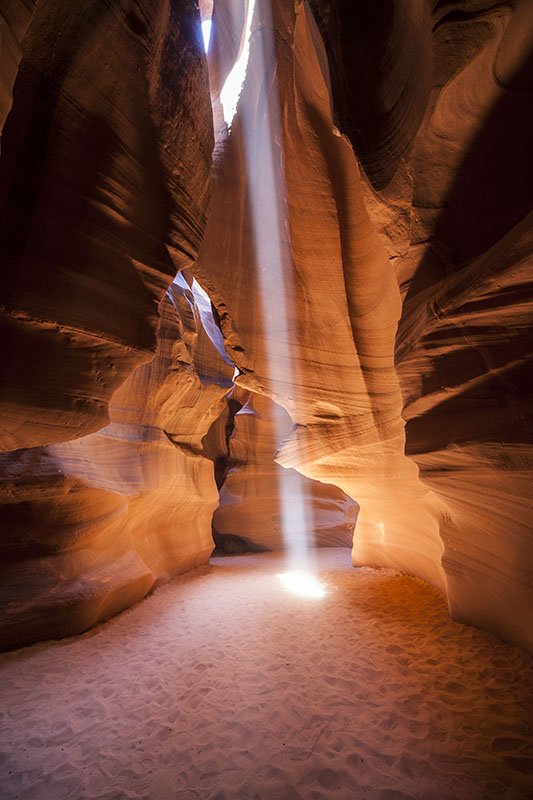
The beam is a season, not a promise
Antelope Canyon's famous light beams appear when the sun climbs high enough to pour directly through the narrow slots in the canyon roof — which means late spring through early fall, roughly March to October, with the strongest, most reliable beams in late spring and summer. The window within the day is just as narrow: beams form around midday, roughly 11 a.m. to 1 p.m., when the sun is nearly overhead. Outside those hours the canyon is still beautiful — swirls of orange, rose, and purple stone — but the shafts of light belong to noon. Dust kicked up (sometimes deliberately, by guides) is what makes the beam visible; on still days it can be faint.
[AFFILIATE: Upper Antelope Canyon tours] · [AFFILIATE: Lower Antelope Canyon tours]
Upper vs. Lower: the photographer's verdict
Upper Antelope — the beam canyon
Upper is where the postcards come from: a flat, sandy floor you walk at ground level, wide chambers, and the strongest beams. It's also the most visited slot canyon in the world — tours move in a steady one-way flow, your time at each chamber is brief, and composing a clean frame means shooting fast in the gaps between groups. Go for the beams; go knowing it's a sprint.
Lower Antelope — the photographer's canyon
Lower is longer, narrower, and more sculptural — ladders connect its levels, the walls twist into shapes Upper never attempts, and its color palette shifts cooler, toward lavender and gold. It rarely produces the classic vertical beam, but it gives photographers something Upper can't: time. Groups are smaller, the pace is slower, and the abstract frames are endless.
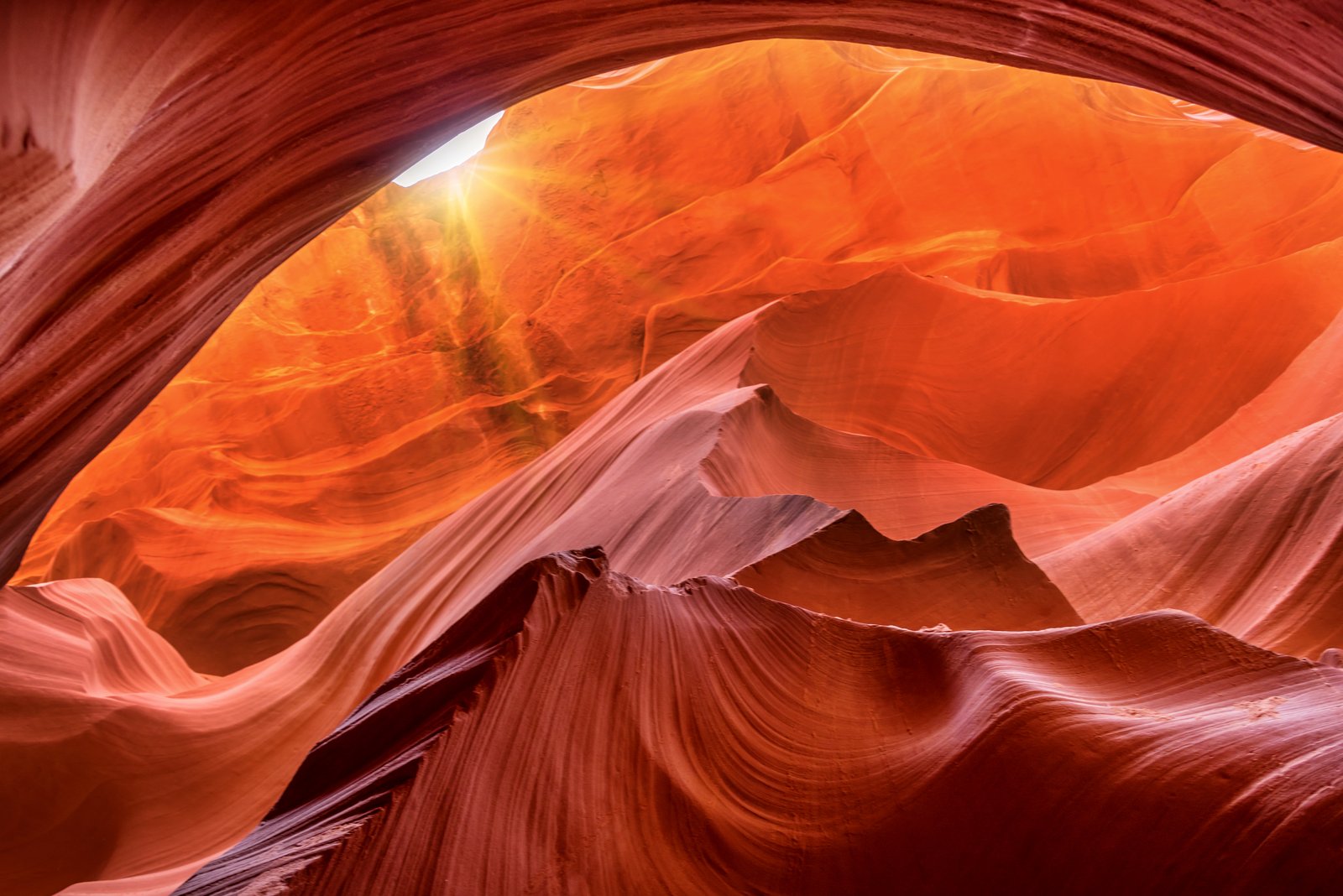
Our honest split: one trip, one canyon — choose Upper for the beam, Lower for the portfolio. Doing both? Shoot Upper at midday for beams, Lower in the morning when its angled light turns the walls to ribbon.
Booking the right tour time
- Beam season sells out weeks ahead at midday — reserve the late-morning to early-afternoon departures first, and treat shoulder hours as the fallback, not the plan.
- Shoulder season (late fall, winter) trades beams for thinner crowds and softer, more even light — arguably better for Lower Canyon abstracts.
- Both canyons sit on Navajo land and are visitable only with authorized Navajo guides — there is no self-guided option, and flash flooding closes the canyons without debate. If rain is forecast anywhere in the watershed, expect cancellations and respect them.
[AFFILIATE: Antelope Canyon tours from Page] · [AFFILIATE: hotels in Page]
Shooting inside the slots
- Tripod and bag policies differ by canyon, operator, and tour type, and change over time — check the current rules when you book rather than assuming what was allowed last year.
- Expose for the highlights: the beam and lit floor are far brighter than the walls, and blown highlights don't come back. Bracket when you can, and shoot the beam the moment your group enters the chamber — it shifts fast.
- Phones are genuinely good here: the computational exposure handles the contrast range well. Use the wide lens, tap to expose for the beam, and keep the phone vertical — the canyon is.
- Protect your gear changing lenses — fine sand sifts constantly from the rim. Most photographers pick one lens and leave it on.
Complete the frame: Horseshoe Bend & Page
Ten minutes from the canyons, Horseshoe Bend drops 1,000 feet to the Colorado River's great meander — best at sunrise, when the light reaches the river early and the crowds don't, and again at sunset when the rim glows. Base in Page, where Lake Powell adds blue-water frames and the Glen Canyon Dam anchors the landscape story. One full day — canyon at noon, bend at dusk — is the essential photographer's itinerary.
[AFFILIATE: Horseshoe Bend tours] · [AFFILIATE: rental cars in Page]
About & Disclosure
TRVL Guide is a travel resource site. Some links on this site may be affiliate links — if you book through them, we may earn a commission at no extra cost to you. It helps keep the guides free.