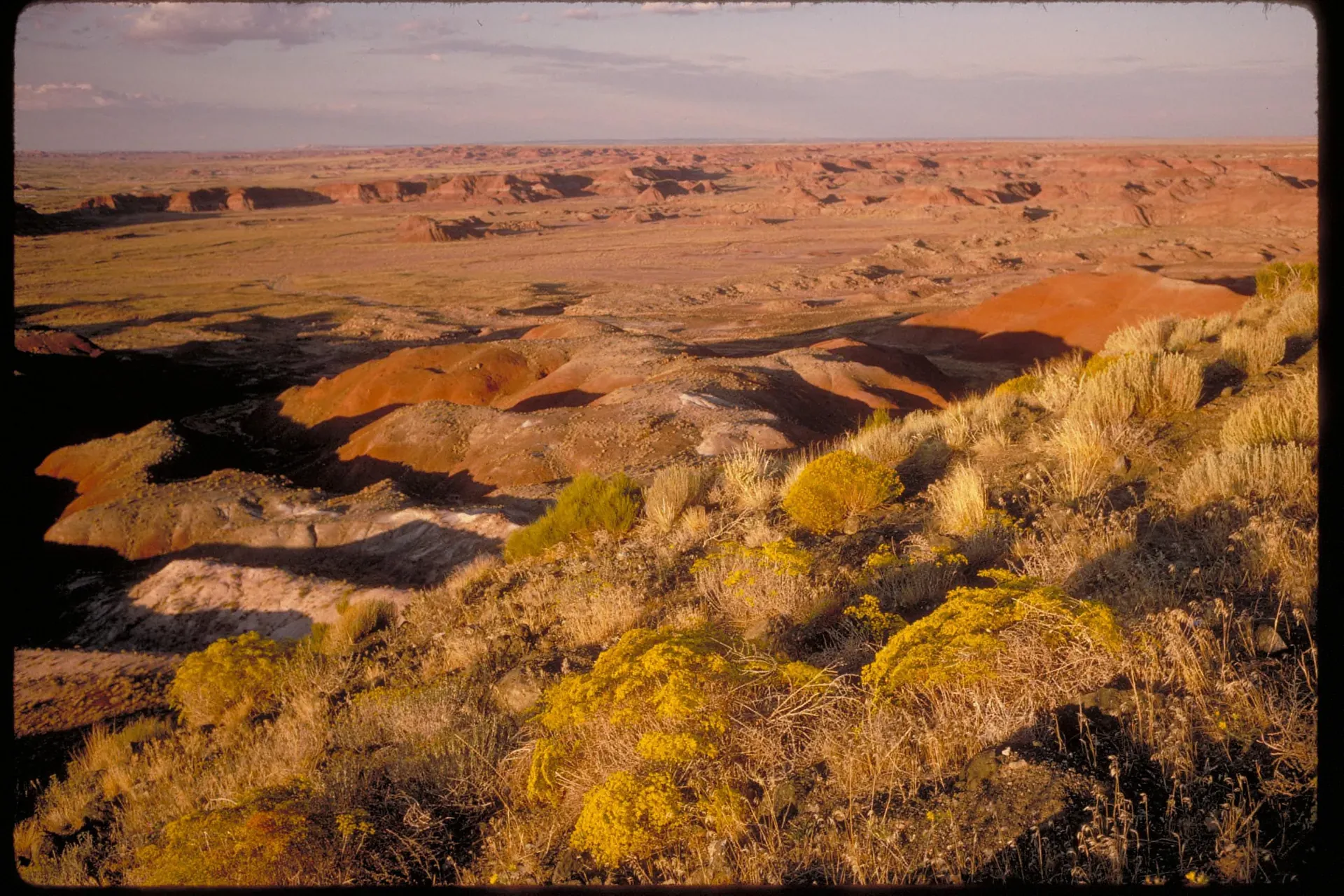
The Painted Desert in Petrified Forest National Park, Arizona, banded red, pink and lavender badlands under a wide sky

Do

WINSLOW AND PETRIFIED FOREST

One Route 66 town and one national park, an hour apart on I-40 and better together than either is alone. This is the pairing guide: the Corner and La Posada in Winslow, then the full 28 mile park road in the order that loops you home. For the whole road, start with our Arizona Route 66 guide.

Some pairings are marketing. This one is geography. Winslow sits on I-40 and historic Route 66 in northeastern Arizona, about 185 miles and three hours northeast of Phoenix via I-17 and I-40, and 58 miles east of Flagstaff. An hour east of Winslow, the same interstate passes the north gate of Petrified Forest National Park, where a single 28 mile park road runs from the Painted Desert in the north to the biggest petrified logs in the world in the south. The park even preserves a stretch of the old Route 66 alignment itself. So the trip writes itself: a railroad town that a song made famous in the morning, a forest turned to stone across the afternoon, and a loop route, recommended by the National Park Service itself, that never asks you to drive the same mile twice. Hero photo: the Painted Desert, by NPS staff, public domain, via Wikimedia Commons.

What makes the pairing more than convenient is the contrast. Winslow is human scale and human made: a corner, a mural, a grand hotel built for train passengers in 1930. The park is the opposite, a landscape on a 225 million year clock, where fallen trees became quartz and the hills are striped like watercolor. Do them in one trip and each half explains the other. The railroad and the highway brought people here. The desert is why they stopped.

Winslow and Petrified Forest at a glance

The pairing: Winslow (the Corner, La Posada, downtown Route 66) plus Petrified Forest National Park (Painted Desert, Blue Mesa, Crystal Forest, Giant Logs), joined by I-40 through Holbrook. The drives: Phoenix to Winslow about 185 miles, 3 hours. Flagstaff to Winslow 58 miles, about 1 hour. Winslow to Holbrook 33 miles. Winslow to the park south entrance about 52 miles via Holbrook and Highway 180, and about 60 miles to the north entrance at I-40 Exit 311. The park road: 28 miles, north entrance at I-40 Exit 311, south entrance off Highway 180 at the Rainbow Forest Museum, about an hour of driving with no stops. Park fees (NPS, checked November 2026): $25 per private vehicle, $20 per motorcycle, $15 per person on foot or by bike, good for 7 days; $45 park annual pass; America the Beautiful pass accepted; 15 and under free; cards only, the park is cashless. Park hours: open year round except Thanksgiving and Christmas; park road 8 a.m. to 5 p.m. Mountain Standard Time. Time needed: one long day minimum, a weekend to do it justice. One live change: the Painted Desert Visitor Center is closed for construction, expected to reopen in June 2027; visitor services are at the Painted Desert Inn. NPS had not posted separate 2027 fees or hours at publish time, so confirm both at nps.gov/pefo before a 2027 trip.

Why these two go together

The case rests on three things: distance, direction and difference.

Pairing · Distance

Close enough to share a day, far enough to feel like two trips

Winslow to the park is roughly an hour of interstate, with Holbrook in between as the fuel, food and fallback town. That is close enough that a morning in Winslow and an afternoon in the park is a relaxed plan, not a stunt, and far enough that the two halves never blur. You breakfast in a railroad hotel dining room and you are looking at 225 million year old stone trees before lunch has worn off. Verdict: if you are driving I-40 past one of them, skipping the other is the only wrong plan.

Pairing · Direction

The loop the Park Service already designed

Petrified Forest has two entrances and one road between them, and the National Park Service tells eastbound I-40 travelers exactly what to do: exit at Holbrook, Exit 285, drive 19 miles south on Highway 180 to the south entrance, drive the 28 mile park road north, and rejoin I-40 at Exit 311. Starting from Winslow, that advice becomes a perfect loop. East on I-40 to Holbrook, south into the park, north through it, then west on I-40 straight back to Winslow. Westbound travelers simply run it in reverse, entering at Exit 311 and exiting toward Holbrook. Verdict: enter south, exit north, from Winslow. The park reads in order and the drive home is the short leg.

Pairing · Difference

A song and a stone forest

Winslow gives the trip its story: Route 66, the Santa Fe Railway, a Fred Harvey hotel and a lyric everyone in the car can sing. The park gives it scale: the Painted Desert, petroglyphs, a pueblo, and logs that were trees when dinosaurs were new. Either one alone can feel thin to a skeptic, Winslow too quick, the park too quiet. Together they balance. The town warms you up for the landscape, and the landscape earns the town its place on the map. Verdict: sell the trip to your travel partners as both. It is an easier yes, and it happens to be true.
Winslow: corner, hotel, downtown

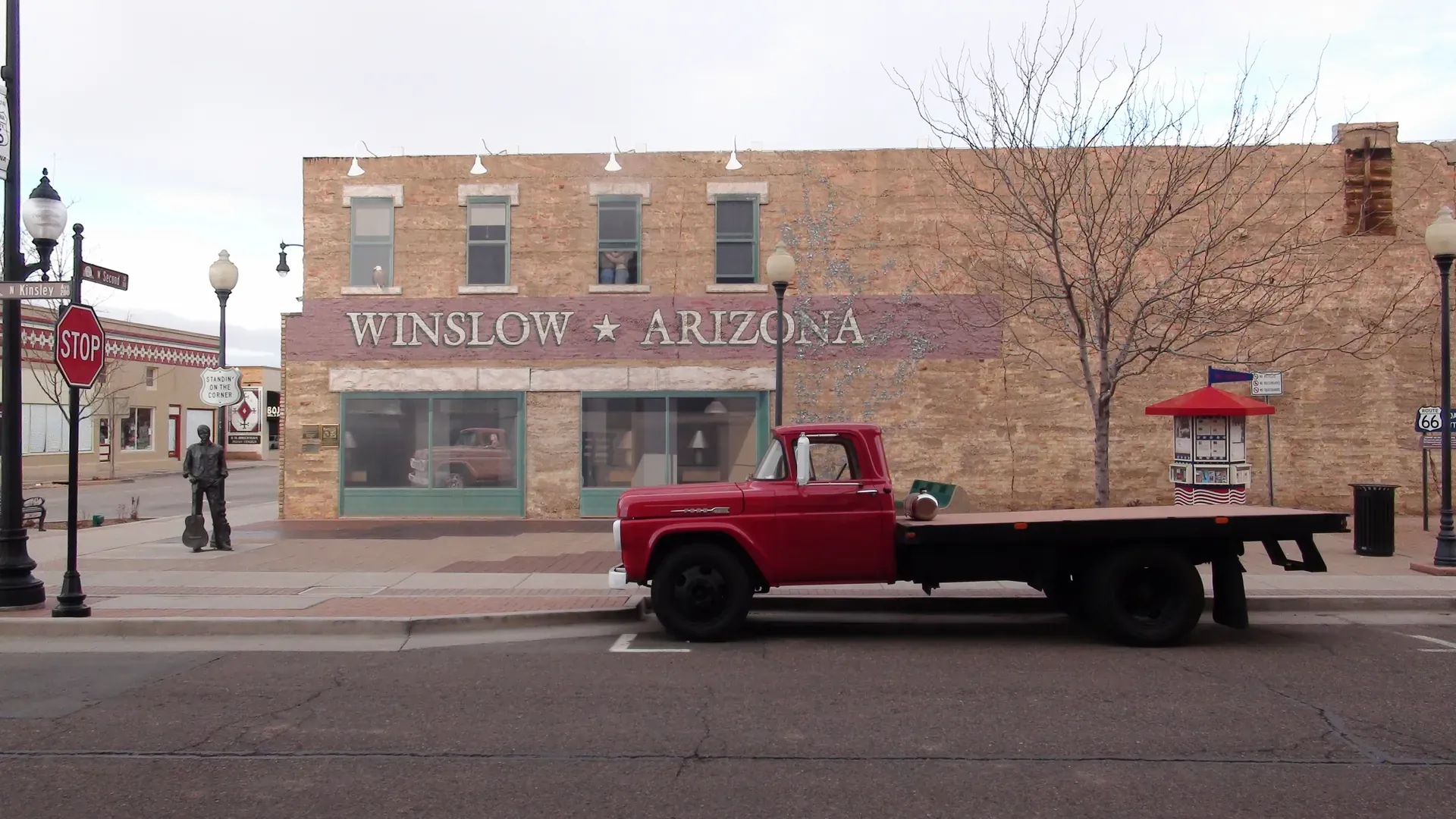
Standin on the Corner Park in Winslow, Arizona, with the red flatbed Ford, the troubadour statue and the Winslow mural
Standin’ on the Corner Park, Winslow. Photo by Tpaairman, CC BY-SA 3.0, via Wikimedia Commons.

Winslow rewards about half a day, and it divides cleanly into a ten minute photo, a one hour masterpiece and a slow wander. Do them in that order.

Town · The Photo

Standin’ on the Corner Park

At North Kinsley Avenue and East 2nd Street, old Route 66 through downtown, a small park marks the most famous corner in Arizona music. The song is “Take It Easy,” written by Jackson Browne and Glenn Frey and recorded by the Eagles, and the park, opened in 1999, builds the lyric in brick and bronze: a two story trompe-l’oeil mural by John Pugh, a red flatbed Ford, and the bronze statue “Easy” by Ron Adamson, a troubadour with a guitar standing on the corner. A second statue, of Glenn Frey, was added in September 2016 after his death. It is free, it is quick, and it is genuinely fun, especially with the song queued up as you pull in. Verdict: ten to twenty minutes, photos first, then go see the building that makes Winslow matter beyond the song.

Town · The Masterpiece

La Posada, the last great railroad hotel

Three blocks east at 303 East 2nd Street stands the real reason to stop in Winslow. La Posada opened in May 1930 as the last of the great Fred Harvey railroad hotels built with the Santa Fe Railway, and its architect, Mary Colter, considered it her best work. She designed it as a grand Spanish hacienda, buildings, gardens, furniture and all, and it ran as a hotel until 1957, when it was gutted and turned into railroad offices. Demolition was a real possibility until Allan Affeldt and Tina Mion bought it in 1997 and began the restoration that reopened it as a hotel. Today you can stay here, eat in its dining room, the Turquoise Room, or simply walk the grounds and galleries, which costs nothing and takes an hour you will not regret. Book rooms well ahead in busy seasons; it is the best historic stay on Arizona Route 66. Verdict: if you only do one thing in Winslow besides the corner, this is it. If you can sleep one night of the trip here, do.

Town · Downtown

Second Street and the railroad town around it

The rest of downtown Winslow is a compact, walkable few blocks along 2nd and 3rd Streets, the paired one way streets that carried Route 66 through town. Expect gift shops trading on the corner, coffee and lunch spots, murals, and the working railroad never more than a block or two away; Winslow is still a Santa Fe, now BNSF, town at heart. The Old Trails Museum covers the deeper local story, from the railroad to Route 66 to the Harvey era, in a small storefront museum that pairs well with La Posada. None of this needs a schedule. Park once near the corner and walk it all. Verdict: downtown is the connective tissue, good for an hour of wandering and lunch before the park, not a separate destination.

[AFFILIATE: La Posada and Winslow stays]

Petrified Forest, south to north

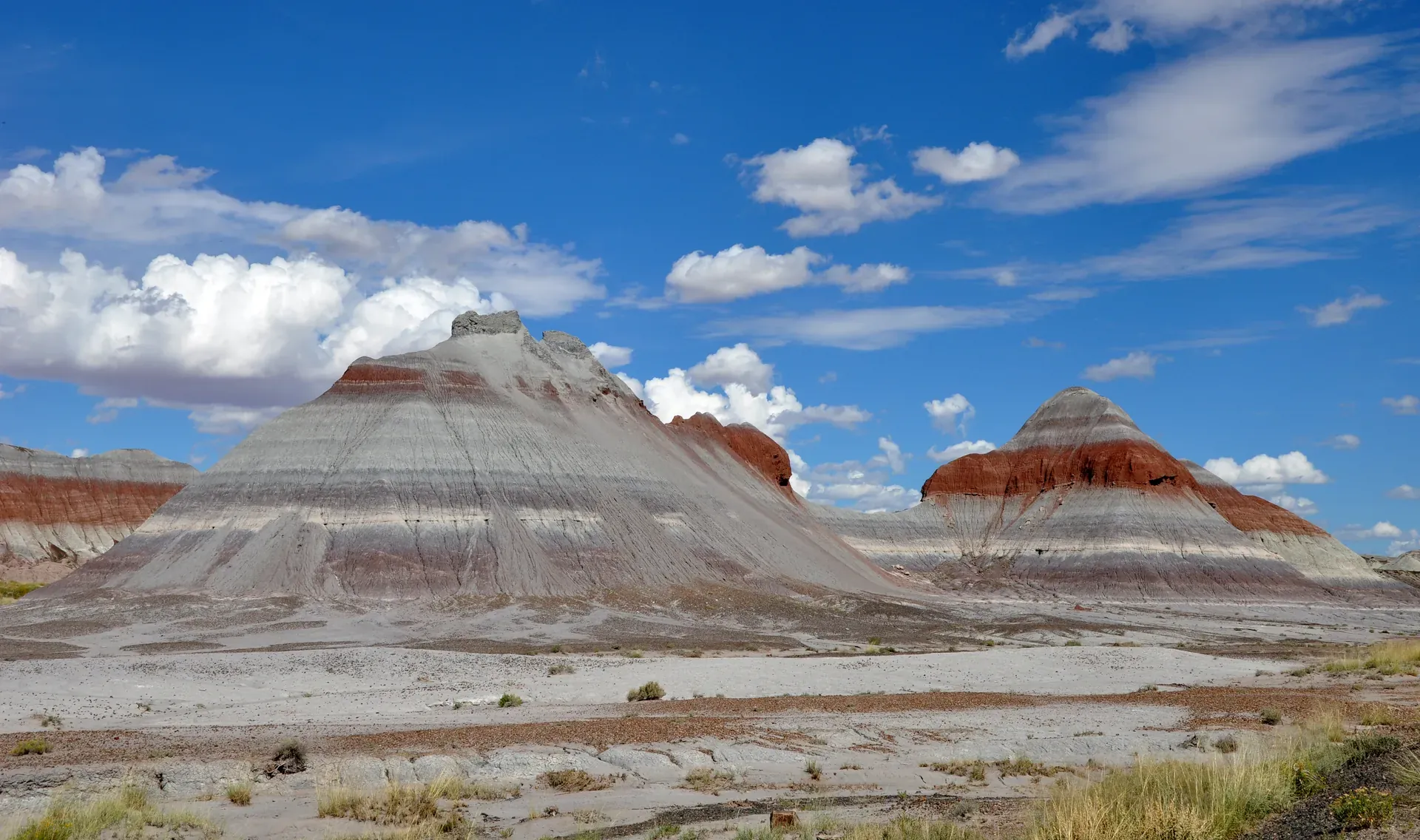
The Tepees in Petrified Forest National Park, cone shaped badlands striped in blue, purple and rust
The Tepees, mid park on the park road. Photo by Finetooth, CC BY-SA 3.0, via Wikimedia Commons.

Driving the loop from Winslow, you enter at the south gate and read the park in the order below. Coming from the east, reverse the list. The road is 28 miles end to end, about an hour with no stops; with the walks below, plan on three to five hours inside the park, and remember the road closes at 5 p.m.

Park · South Gate

Rainbow Forest Museum and Giant Logs

Start at the Rainbow Forest Museum, the south entrance hub, for the fossil exhibits and the park film context, then walk out the back door onto the Giant Logs Trail, a 0.4 mile loop among some of the largest and most colorful petrified logs in the park, including the massive log known as Old Faithful. It is the best possible introduction: the biggest wood first, while legs and light are fresh. The nearby Long Logs and Agate House trails add time here if you have it; Agate House is a small pueblo built from petrified wood itself. Verdict: museum plus Giant Logs, 45 minutes. Non negotiable stop.

Park · The Crystals

Crystal Forest

A few miles north, the Crystal Forest Trail, a 0.75 mile paved loop, winds through one of the densest fields of petrified logs in the park. The name comes from the quartz and amethyst crystals that formed inside the hollow logs as the wood turned to stone, and on a sunny day the broken log ends glitter. This is the stop where the science clicks for kids and skeptics alike, because the logs are close, numerous and clearly trees in every detail except temperature. Verdict: the best close up petrified wood walk in the park. Thirty to forty minutes.

Park · Overlook and Bridge

Jasper Forest and Agate Bridge

Continue north to the Jasper Forest overlook, where a valley floor is scattered with petrified logs in red jasper tones, one of the largest accumulations of petrified wood in the park, best taken in with binoculars or a zoom lens. Just beyond, Agate Bridge is a single petrified log more than 100 feet long spanning a wash, a tree that became a stone bridge. You view it from the overlook; walking on it is prohibited, and a concrete support added long ago keeps it intact. Verdict: two quick stops, ten minutes each, that show the park at valley scale after the close ups.

Park · The Walk

Blue Mesa

Mid park, a short spur road loops out to Blue Mesa, and the 1 mile Blue Mesa Trail drops about 100 feet off the rim into badlands banded in blue, purple and gray. It is the one walk in the park that puts you inside the landscape instead of looking at it, among bentonite hills that erode into fluted cones, with petrified wood scattered through the washes. The climb back out is short but real, and there is no shade at all. Verdict: the best trail in the park and the one to pick if you only walk one. Allow an hour, carry water.

Park · Badlands and Petroglyphs

The Tepees, Newspaper Rock and Puerco Pueblo

North of Blue Mesa the road passes The Tepees, cone shaped badlands striped like the photo on this page, then reaches the park’s human history. At Newspaper Rock, an overlook with viewing scopes looks down on boulders covered in more than 650 petroglyphs carved by ancestral Puebloan people over centuries; you view from above and do not climb down to the rocks. Across the road area, Puerco Pueblo is the excavated outline of a large ancestral Puebloan village of around 100 rooms, home to as many as 200 people at its peak, with a short paved loop through the ruins and more petroglyphs along the way. Between them, a roadside pullout marks where historic Route 66 crossed the park, the only section of the Mother Road protected inside a national park, with a rusted vintage Studebaker marking the old alignment. Verdict: give this cluster 45 minutes. It is the park’s second story, people this time, and it lands harder after the empty miles.

Park · North End

Painted Desert Inn and the Painted Desert rim

The road ends, or begins, at the rim of the Painted Desert, where overlooks including Kachina Point, Chinde Point and Tiponi Point look over miles of red, pink and lavender badlands in the Chinle Formation. On the rim sits the Painted Desert Inn, a National Historic Landmark that began in the 1920s as the Stone Tree House, built of petrified wood by Herbert David Lore, was bought by the park in 1936, redesigned in Pueblo Revival style by NPS architect Lyle Bennett and rebuilt by the Civilian Conservation Corps, reopening on July 4, 1940. The Fred Harvey Company ran it after the war, Mary Colter redid the interiors, and Hopi artist Fred Kabotie painted its murals. Today it is a museum, and right now it is also doing duty as the park’s north visitor center while the Painted Desert Visitor Center is closed for construction. Verdict: end here in late light if you can. The Painted Desert at golden hour is the park’s closing argument.

Two plans that work

The one day plan

Leave Winslow by 8 a.m. after an early corner photo, when the light is good and the tour buses are not. Coffee and the corner take thirty minutes if you did La Posada the evening before, which is the smart way to run this day: arrive in Winslow the night before, tour the hotel and downtown, and keep the morning short. Drive east on I-40 to Holbrook (33 miles), top up fuel, then take Exit 285 and Highway 180 south, 19 miles, to the park’s south entrance as early in the park day as you can manage. Work the park south to north as listed above: Giant Logs and the museum, Crystal Forest, Jasper Forest and Agate Bridge, the Blue Mesa walk around midday, then Tepees, Newspaper Rock and Puerco Pueblo, finishing at the Painted Desert rim and the Painted Desert Inn in the best light of the day. Exit at I-40 Exit 311 before the 5 p.m. road closing and run west on I-40 about an hour back to Winslow, or thirty minutes to Holbrook, for dinner and bed. Total driving is roughly 175 miles, and the day is full without being frantic, provided you do not add Meteor Crater. That is what day two is for.

The weekend plan

Day one, Winslow properly. Drive up from Phoenix or Flagstaff in the morning and give Winslow its half day without a clock: the corner, a slow La Posada tour and lunch in the Turquoise Room, the Old Trails Museum, and a downtown wander. Sleep in Winslow, at La Posada if you booked it, and you have already beaten the one day crowds by a full evening. Day two, the park properly. Enter the south gate at the 8 a.m. opening and take the park at half speed: add the Long Logs or Agate House trail in the south, linger on Blue Mesa, and time the Painted Desert rim for late afternoon. Sleep the second night in Holbrook, which puts the Wigwam Motel and an easy morning start on the table, or return to Winslow. Day three option: if you have a third morning, Meteor Crater, about six miles south of I-40 between Winslow and Flagstaff, or the drive west to a Flagstaff afternoon, turns the pairing into the opening leg of our 7 day Arizona road trip. Our Flagstaff guide picks up exactly where this weekend ends.

[AFFILIATE: hotels in Winslow and Holbrook]

The practical section

Fees. Entrance is $25 per private vehicle, $20 per motorcycle and $15 per person on foot or by bike, good for 7 days, with a $45 Petrified Forest annual pass and the America the Beautiful pass both accepted and visitors 15 and under free. The park is cashless; entrance stations take cards only. Those are the NPS figures checked in November 2026. NPS had not posted separate 2027 fees at publish time, so confirm at nps.gov/pefo before a 2027 trip rather than trusting any guide, including this one.

Hours. The park is open year round except Thanksgiving and Christmas, and the park road runs 8 a.m. to 5 p.m. Mountain Standard Time; Arizona does not observe daylight saving time, and winter openings can be delayed until roads are safe. The Painted Desert Inn museum keeps shorter hours than the park road, so check its posted hours on the NPS site if the inn is a priority. There is no lodging and no campground inside the park; the only overnight option in the park is wilderness camping with a free permit, which is a different trip. Everyone else sleeps in Winslow, Holbrook or Flagstaff.

Visitor center change. The Painted Desert Visitor Center at the north entrance is closed for construction, with reopening expected in June 2027. Visitor center operations have moved to the Painted Desert Inn, about two miles past the north entrance station, and the restrooms, restaurant, gift shop and gas station at the north entrance complex are still operating. At the south end, the Rainbow Forest Museum covers the same basics.

Fuel and supplies. Fill up in Winslow or Holbrook before you turn south on Highway 180; there is no fuel on the 180 leg or along the park road. A gas station operates at the Painted Desert community complex at the north entrance, but treat it as a backup, not a plan. Carry more water than you think you need, plus sun protection and a real hat. Cell service is patchy in the park, so download offline maps in Winslow or Holbrook.

Heat and exposure. This is high desert above 5,000 feet with almost no shade on any trail. Summer afternoons are genuinely dangerous for unprepared walkers, and even spring and fall sun will burn at this elevation. Walk Blue Mesa and Crystal Forest early or late, keep midday for the car and the overlooks, and turn back on any walk if your water is half gone. Winter flips the problem: wind and cold at the rim, and occasional snow or ice that delays opening.

The petrified wood rule. Never collect in the park. Removing petrified wood, or any natural or cultural object, is strictly prohibited and punishable under federal law, down to a pocket sized fragment, and vehicles can be checked. The park exists because early visitors were hauling the forest away by the wagonload. If you want a souvenir piece, the shops in Holbrook and Winslow sell petrified wood collected legally on private land outside the park, which is the honest way to own some.

Pets. Petrified Forest is unusually welcoming to leashed pets on its paved trails by national park standards, but rules are specific and change; check the NPS pets page before bringing a dog, keep it leashed, and never leave an animal in a hot car at a trailhead. In summer heat, the honest answer is usually to leave the dog with a sitter.

Winslow and Petrified Forest questions

How much does it cost to enter Petrified Forest National Park?

Entrance is $25 per private vehicle, $20 per motorcycle and $15 per person on foot or by bike, and the pass is good for 7 days. A Petrified Forest annual pass is $45, an America the Beautiful pass covers entry, visitors 15 and under are free, and the park is cashless, so bring a card. Those are the NPS fees posted in November 2026.

What are the hours at Petrified Forest National Park?

The park is open year round except Thanksgiving and Christmas, and the park road runs 8 a.m. to 5 p.m. Mountain Standard Time. Arizona does not observe daylight saving time. There is no lodging or campground inside the park, so every visit is a day visit inside those hours, and winter opening can be delayed until roads are safe.

Which Petrified Forest entrance should you use from Winslow?

Use the south entrance. Drive east on I-40 to Holbrook, take Exit 285 and follow Highway 180 south for 19 miles to the Rainbow Forest Museum entrance, then drive the 28 mile park road north and exit at I-40, Exit 311, for the straight run back west to Winslow. That is the loop the National Park Service recommends for eastbound I-40 travelers, and it means you never backtrack.

How long do you need for Winslow and Petrified Forest together?

One full day is the minimum and it works if you start early: Winslow in the morning, the park road from late morning to closing, and back to Winslow or Holbrook by dark. A weekend is better. It gives the park a full day at a slower pace, adds Meteor Crater or a Flagstaff evening, and lets you see La Posada and downtown Winslow without watching the clock.

Can you take petrified wood home from the park?

No. Removing petrified wood, or any natural or cultural object, from Petrified Forest National Park is strictly prohibited and punishable under federal law, and the rule covers even a small fragment. If you want a piece to take home, buy it outside the park in Holbrook or Winslow, where shops sell petrified wood collected legally on private land.

Is the Painted Desert Visitor Center open?

Not right now. The Painted Desert Visitor Center at the north entrance is closed for construction, with reopening expected in June 2027, and visitor center operations have moved to the Painted Desert Inn, about two miles past the north entrance station. The restrooms, restaurant, gift shop and gas station at the north entrance complex are still operating during construction.

Keep planning

[AFFILIATE: hotels in Winslow and Holbrook]

About & Disclosure

TRVL Guide is a travel resource site. Some links on this site may be affiliate links. If you book through them, we may earn a commission at no extra cost to you. It helps keep the guides free.

The trvlguide letter

Arizona, in your inbox.

One email a week in season: new guides, event weekends and the desert windows worth planning around, from Phoenix to Sedona to the Grand Canyon. Free, no spam.

Enter your email to join free: